
Where Is Silica Sand Found?
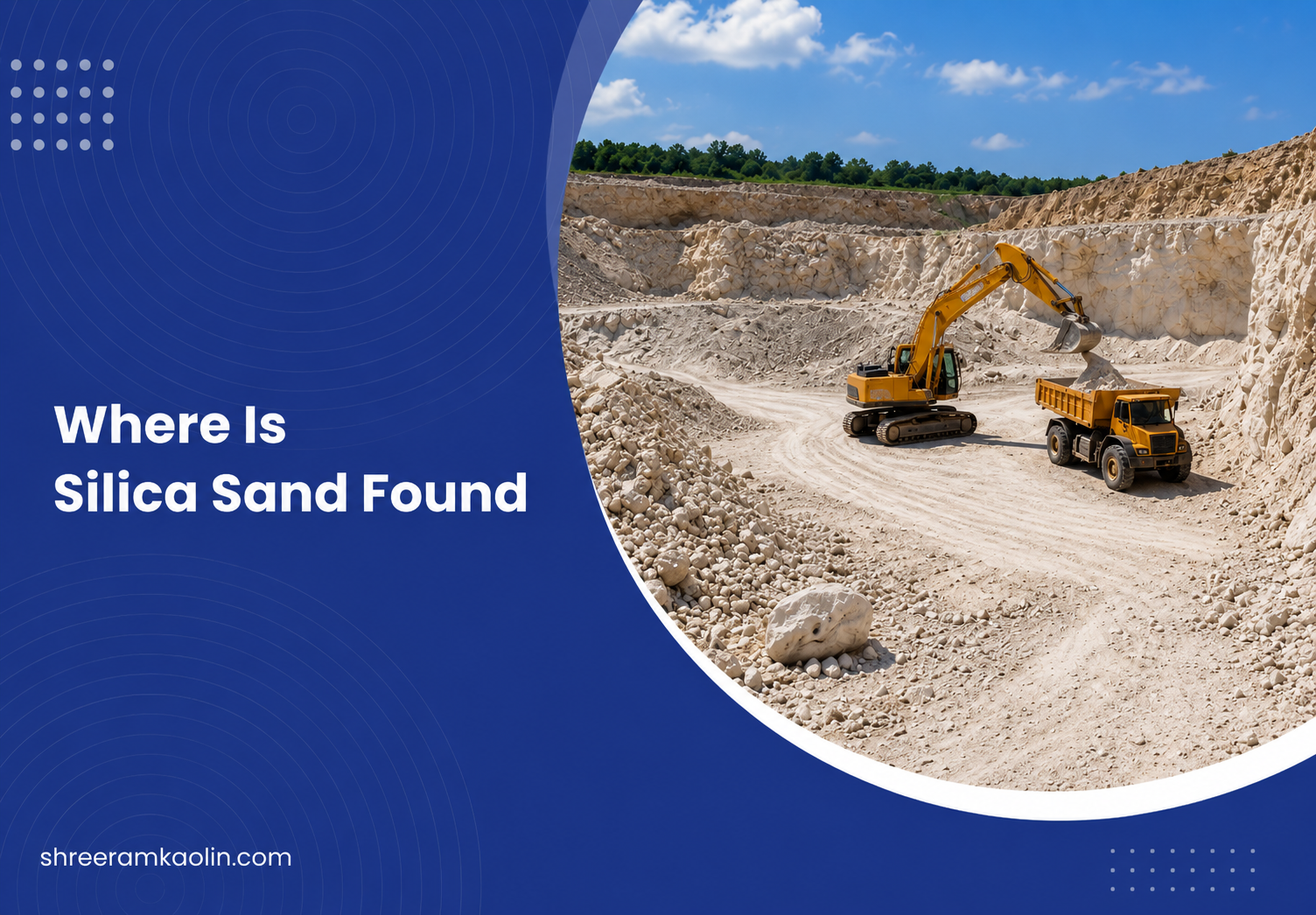
The top five producers of silica sand are the United States ,Australia, India, China and Brazil. The highest-purity deposits suitable for industrial purposes (above 99.5% SiO2) are found in certain geological areas, such as Wisconsin and Illinois in America, Rajasthan and Gujarat, in India, or Queensland, in Australia.
All of these items share the same raw material: the sand that makes up the screen on your smartphone, your glass window or the concrete supporting your office. Silica sand, one of Earth’s most commonly used industrial minerals, is a material that most people don’t even think twice about.
Silica Sand is not scarce like rare earth metals and precious stones. You can find it on almost every continent. It’s buried deep in geological formations which took millions of year to form. It’s not finding the mineral that’s difficult, but finding it pure enough for industrial purposes.
The guide explains where you can find silica around the globe, what countries are the biggest producers, and the differences between deposits from key areas like India and the United States. Learn how raw sand becomes an industrial grade material, and why it’s important to maintain purity.
Silica Sand: What Is It And Why Does It Matter?
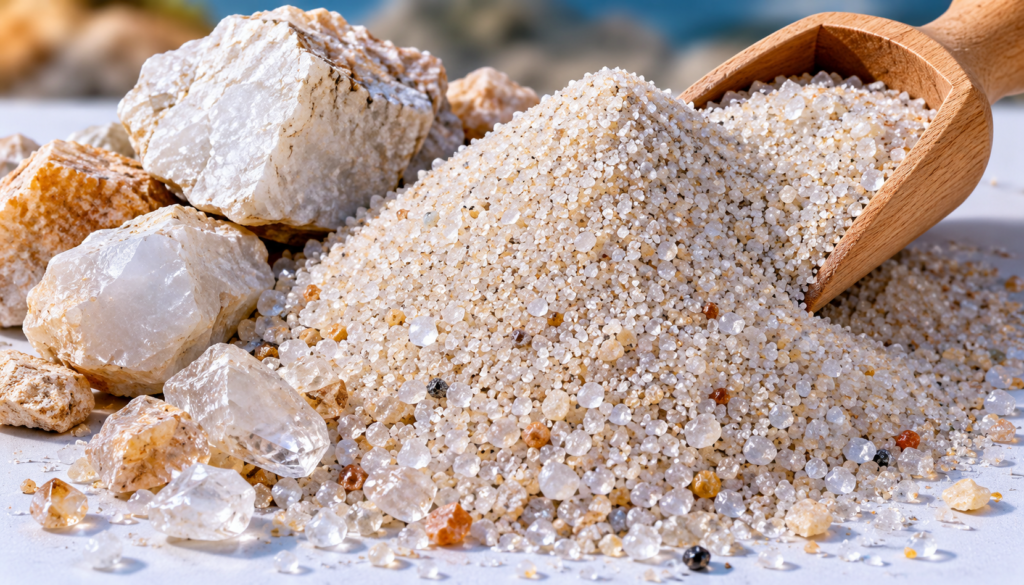
The main component of silica sand (SiO2) is silicon dioxide. The main difference between it and regular river or beach sand is its purity. Silica sand for industrial use must have a minimum SiO2 content of 98.5%. If it falls below that level, the sand will require expensive refining and may not be suitable for high-end production.
Applications are very diverse. The glass industry uses silica as the primary raw material in everything from solar panels and fiber optic cables to windows, mirrors and fibre optic cables. It is used in hydraulic fracturing, where the sand grain props open rock formations and releases trapped hydrocarbons. It is used in foundries to make molds for metal casts and by the construction industry as mortar, concrete and adhesives. Ultra-pure silicon is used by electronics manufacturers to make semiconductors, specialized coatings, and other products.
The U.S. Geological Survey reports that industrial sand, which consists primarily of silica, is used for a variety of applications including glassmaking, hydraulic fracturing, foundry and abrasive. This mineral is essential to modern manufacturing, but it’s easy to forget.
Silica Sand: How Does It Form Naturally?
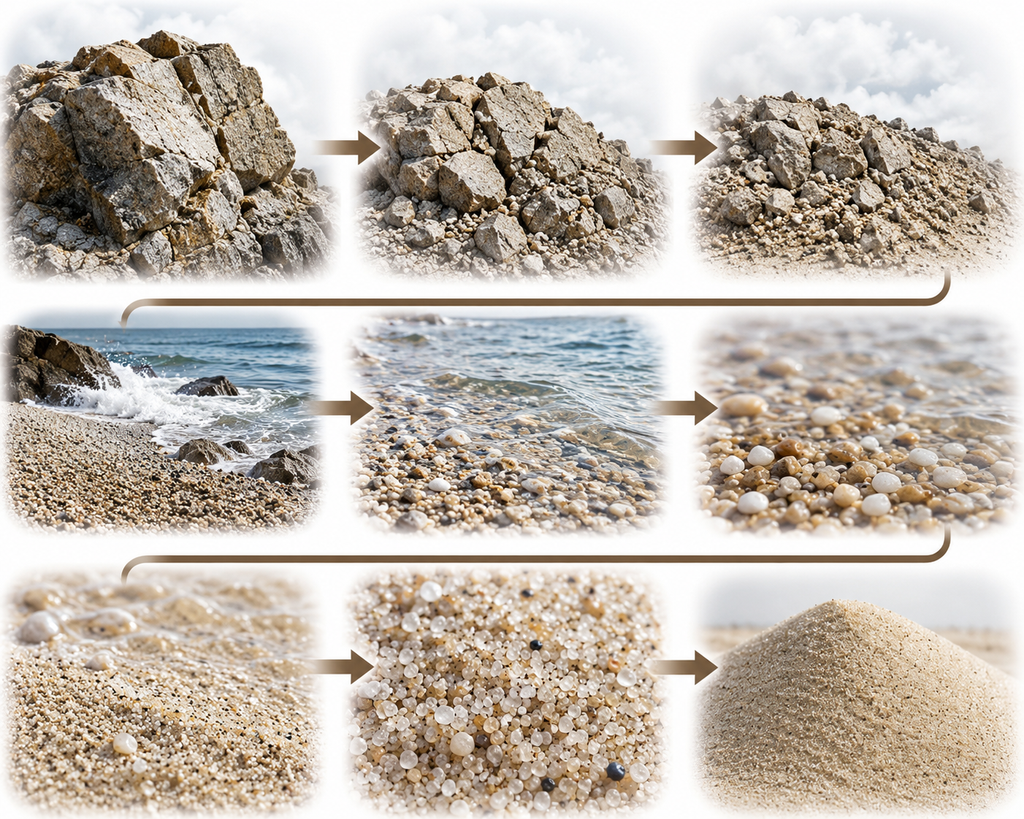
Silica sand is formed by the weathering and erosion of rocks that contain quartz. Quartz crystals are found in granite, quartzite and sandstone. These rocks are broken down over millions of years by wind, water and temperature variations. The softer minerals dissolve or erode away, while quartz–being chemically resistant and physically durable–accumulates.
As eScholarship notes in its research, weathering any rock containing quartz creates sand. This is true whether the material that created the rock was igneous or sedimentary. Sand is a part of a cycle that involves rock formation, erosion and sand.
The highest-quality silica deposits tend to be “supermature”–meaning they have been processed repeatedly by geological forces, stripping away impurities and concentrating the quartz content. This type of deposit is particularly prolific in ancient marine environments, deltas and aeolian dune system.
Silica Sand Hotspots Around the World
The distribution of high-purity deposits is uneven around the world. Quartz-bearing rock is found almost everywhere. However, industrial grade silica-sand concentrations–more than 98.5% of SiO2- are only present in certain geological formations.
The five largest producing regions in the world are:
| Rank | Country/Region | Major Locations |
| 1 | United States | Wisconsin, Illinois, Texas, Minnesota |
| 2 | India | Rajasthan, Gujarat, Tamil Nadu |
| 3 | China | Inner Mongolia, Fujian |
| 4 | Australia | Queensland, Western Australia |
| 5 | Brazil | Bahia, Minas Gerais |
Top 10 Silica Sand Producers Countries (up to 2026)
Globally, the silica industry is dominated a few nations that have both large deposits and well-developed mine infrastructure. The top 10 producers of silica sand as of 2026 are listed below:
| Country | Major Deposits / Regions | Primary Uses |
| USA | Wisconsin, Illinois, Texas, Minnesota | Fracking, glass, foundry |
| Australia | Queensland, Western Australia | Glass, foundry, export |
| India | Rajasthan, Gujarat, Haryana, Tamil Nadu | Glass, foundry, ceramics |
| China | Jiangsu, Fujian, Anhui | Glass, electronics, ceramics |
| Brazil | São Paulo, Minas Gerais | Glass, construction |
| Germany | Saxony-Anhalt, Bavaria | Glass, foundry, chemical |
| Spain | Cuenca, Toledo | Glass, ceramics |
| UK | Norfolk, Yorkshire, Surrey | Glass, sports turf, filtration |
| Turkey | Şile, Istanbul region | Glass, construction |
| Malaysia | Terengganu, Pahang | Glass, export |
United States dominates global production due to its geological riches and robust manufacturing industry. Australia is a key exporter, providing Asian markets with sufficient reserves.
Silica Sand In The United States
This position was built upon the ancient geological formations that stretch across the Midwest.
St. Peter Sandstone is the largest quarried formation of silica in the United States. It extends from Illinois to surrounding states. The University of Illinois Urbana-Champaign states that the St. Peter Sandstone has been a major aquifer in Illinois for many decades and is a significant source of silica. This marine sand was deposited hundreds of millions years ago in an environment of shallow water. It’s exactly the type of geological maturity required to produce high-purity deposit.
Wisconsin, especially in its western and central counties is another major powerhouse. This is where Jordan Sandstone or similar formations are found. The sands used for hydraulic fracturing are sought-after because they have a consistent grain size, and high compressive strengths.
Texas and Minnesota both contribute in a significant way. Texas’ deposits are used by both oil and gas companies and glass makers, whereas Minnesotan deposits supply foundries and other specialty industries.
These states provide silica for a variety of applications, including:
- Flat glass, windows and containers
- Hydro-fracturing — Proppant for oil wells
- Molds for Metal Parts
- Industrial uses — Filters, abrasives and specialty polymers
Silica Sand Is Found In India
India’s reserves of silica are not only notable for the volume, but also for their diversity. The deposits are located in several states with different geological features and grades.
Gujarat has two of India’s most productive regions for silica: Kutch Bhuj and Rajpardi. Gujarat’s coastal geology and sedimentary rocks produce sands that are ideal for the glass industry.
Rajasthan has high-grade deposits in the areas of Ajmer and Bhilwara. Its metamorphic terrain and sedimentary deposits have produced quartz-rich formations which are used by both the domestic and international glass industry.
Andhra Pradesh makes a contribution through its deposits in Prakasam, Nellore and other districts where the geology of coastal and riverine areas has concentrated silica with high purity. Tamil Nadu contributes to India’s reserves through deposits at Salem and Karur that support ceramics and foundry applications.
India’s Bureau of Mines reports that silica deposits are found throughout the country, including in Maharashtra and Madhya Pradesh. They can also be found in Bihar, Odisha, Bihar, Bihar. This makes India the largest producer of silica in the world.
Silica Sand Deposits Around the World
United Kingdom
UK silica mining has been around for a very long time. The records of the Borough Council of King’s Lynn show that silica has been mined for many centuries in Norfolk. Medieval documents also indicate exports of glass-sand out of King’s Lynn. England’s main silica-producing regions today include Norfolk, Yorkshire and Surrey. UK silica is used primarily in the production of glass, sport turf (golf course, for instance, requires specific grades), as well as water filtering.
France
France is home to some of Europe’s best silica, especially around Fontainebleau south of Paris. Wikipedia states that the Fontainebleau Sandstone is composed of fine white sand, which was about fifty meters in thickness. It has been described as the purest form of silica anywhere on earth. According to a market report published by Yahoo Finance UK, the French silica market is expected to reach USD 540.6 millions in 2023.
Saudi Arabia
Saudi Arabia presents an interesting case. Saudi Mining Consulting estimates that the kingdom has more than one billion tons (or 98% pure) of silica-sand deposits. The deposits near Tayma, in the northwestern part of Saudi Arabia, are being actively mined to export glass products. The kingdom imports construction sand despite its abundant resources, as desert sand, which has been rounded down by wind erosion, lacks the right shape for concrete. Even though they are both located in the same nation, high-purity silica industrial sand is fundamentally different from ordinary desert sand.
Mexico
Mexico’s silica deposit is spread across several states and has seen a significant increase in production over the last decade. Deposits in Mexico support the glass and ceramics industry as well as supply chains for export to North American and American markets.
What Is The Manufacturing Process And Grading Of Silica Sand?
The first step is to find a silica deposit. The conversion of raw sand to industrial grade material is a complex process.
First step : exploration and mining. Geologists use 3D mapping and advanced geological modeling to confirm and identify deposit locations. The most popular extraction method is open-pit mining, but dredging can be used in cases where the deposits are under water or on riverbeds.
Processing Step : The raw sand will be crushed, washed and screened in order to remove organic matter and clay. The magnetic separation can be used to eliminate iron-bearing mineral that could affect the purity level.
Grading Step : The silica-sand processed is graded based on its purity and size.
Three main grades:
- Grade : Glass of ultra-high purity, 99.5% or more SiO2. It is used in flat glass production, as well as specialty glass for display screens, solar panel, optical fibres, and speciality glass. The most expensive and demanding grade.
- Foundry Grade : Characterized more by a consistent and uniform grain size than pure purity. Casting molds are used in metal fabrication. For dimensionally precise metal components, it is important to have uniform grain sizes.
- Grade Construction : Purity levels lower than those acceptable for structural uses. Use as aggregates in mortars and adhesives. The volume is more important than chemical precision.
Grades vary widely depending on the application. Both a semiconductor company and a building firm might use the same “silica” but are using fundamentally different material.
Silica Sand Global Supply Chains
Silica sand does not receive much attention from the public, but it is essential to manufacturing. The right silica grade is essential for many industries, including glass, electronics, oil production, construction and renewable energy. Demand patterns continue to change as solar panel production increases globally, and the fracking industry fluctuates in line with energy prices.
As industries worldwide continue to depend on high-quality silica for manufacturing and infrastructure development, sourcing from trusted suppliers becomes increasingly important. Premium-grade silica sand for industrial applications plays a vital role in glass production, foundries, construction materials, and renewable energy projects.
Conclusion
Where can you find silica? There are deposits of silica sand almost everywhere. But the ones worth mining combine the geological purity with the accessibility and grain size characteristics that industrial users require.
Silica sand can be found in sandstone mountains of Wisconsin, coastal plains of Andhra Pradesh and even the hills of Wisconsin. It is an essential mineral for modern living. This remarkable mineral is responsible for every glass window, silicon chip, water filter and concrete structure.
The importance of high-quality, reliable silica deposits is only going to increase as the global demand for this material continues to rise. This growth will be driven by construction booms and advances in manufacturing. India is well-positioned, thanks to its diverse and plentiful reserves, to meet this demand in the coming decades.

