
kaolinite : Uses, Properties, Composition and Industrial Specification
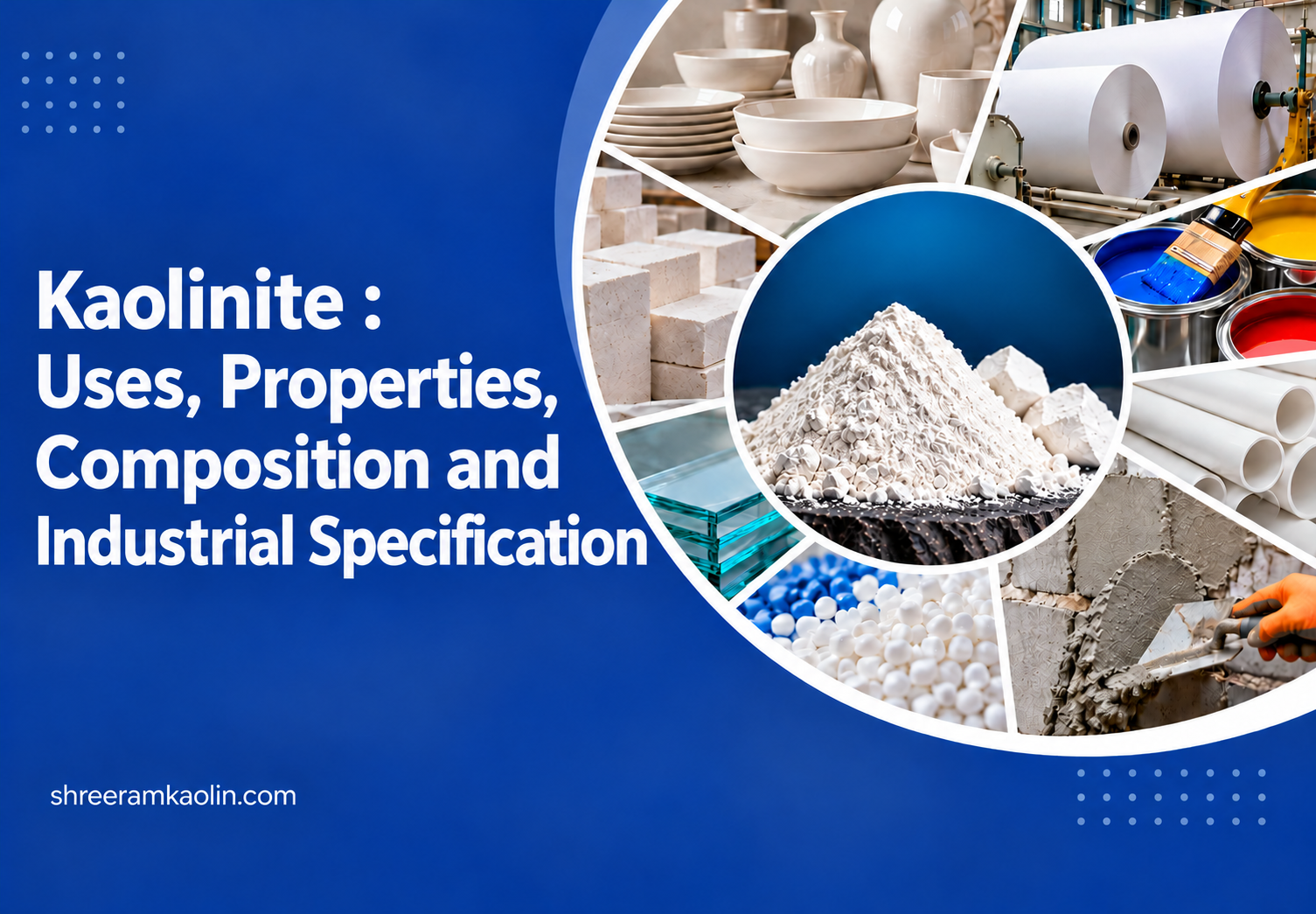
Kaolinite is one of the most common naturally occurring clay minerals and is used in ceramics, paper, paints and coatings, in rubber and in other industrial applications. It is valued as a raw material by manufacturers due to its fine particle structure, natural whiteness, thermal characteristics and chemical stability.
Kaolinite is the principal mineral found in kaolin, commonly known as China clay.Manufacturers can use this knowledge of its composition, properties, industrial applications, and specifications to choose the appropriate materials for their manufacturing needs.
What Is Kaolinite?

Kaolinite is a hydrated silicate of aluminium of the phyllosilicate group. It is mainly formed by the alteration or breakdown of Al2Si2O5(OH)4 (Feldspar) by weathering or hydrothermal process.
Because of its stratified nature and the shape of its particles, it can be used in a number of manufacturing processes.Quartz, mica, feldspar and iron bearing minerals can be present in natural deposits. The impurities can affect the color, brightness, particle size, and overall performance of the material..
Chemical Composition of Kaolinite
Kaolinite’s chemical formula is Al₂Si₂O₅(OH)₄.
It is composed of a sequence of silica and alumina sheets that are bonded together.
Pure kaolinite is thought to have the composition:
- Silicon dioxide (SiO₂): 46.5%
- Aluminium oxide (Al₂O₃): 39.5% S
- tructurally bound water: 14.0%
The values may be different from commercial kaolins due to natural impurities and processing. Kaolinite has a special thermal behaviour which is important in ceramic production because it is release of structurally bound water and some mineralogical changes when heated.
Key Properties of Kaolinite
- Fine Particle Structure: Kaolinite has microscopic, plate shaped particles which affect dispersion, surface finish, opacity and processing properties.
- Natural Whiteness: The high quality kaolin can give natural white appearance to the finished product. May be discoloured and lack luster due to iron and titanium impurities.
- Chemical Stability: Kaolinite is relatively stable in many industrial processes, which makes it suitable as a filling material, an extender, and a raw material of ceramics.
- Low Shrink Swell Behaviour: Kaolinite tends to have low shrink swell behaviour compared to other expansive clay minerals such as smectite.
- Thermal Behaviour: Heating causes kaolinite to lose hydroxyl groups and to become other mineral phases.This process affects the firing qualities and the characteristics of the finished products of ceramics.
Major Industrial Uses of Kaolinite
- Ceramics and Porcelain
The clay containing kaolinite is extensively used in the manufacture of porcelain, sanitary and table ware, wall and floor tiles.It brings the element of aluminium and silica to a ceramic formulation, affects workability, firing behaviour and the quality of the finished product. Different grades are selected by the manufacturers as per the purity, particle size, whiteness, firing requirements etc.
2. Paper Manufacturing
Kaolin is used in paper making industry as a filler and coating pigment.It improves surface smoothness, brightness, opacity and printability depending on the grade and formulation. Some of the most significant selection criteria include particle size distribution and dispersion.
- Paints and Coatings
Kaolin is used in paints and coatings as an extender pigment, which can affect the texture, surface appearance, opacity and application characteristics of paints and coatings. It is effective depending on the particle size, brightness and compatibility with other formulation ingredients.
- Rubber and Plastics
A few grades of kaolin are selected for use as fillers in rubber and plastic products. They may affect stiffness, surface finish, dimensional behavior and process properties. With polymer system and the amount of filler added, the level of performance varies.
- Fibreglass Manufacturing
Some forms of fibreglass use kaolin as a source of alumina and silica. A specific grade is appropriate depending on chemical composition, impurities and compatibility with the manufacturing process.
- Other Industrial Applications
The other uses of Kaolin are in making adhesives and sealants, construction products, refractories and specialty products. Material properties are required for each application, depending on the manufacturing requirements.
Industrial Specifications of Kaolinite
The specifications differ in the industries depending on the application and customer needs. Important parameters include:
- Chemical composition: Levels of silicon dioxide, aluminium oxide, iron oxide and titanium dioxide.
- Whiteness and brightness: for ceramic, paper, paint and other light coloured products.
- PSD – Affects dispersion, surface finish and processing performance
- Moisture content: Impacts storage, transportation and material handling.
- Residue and coarse particles: Aid in uniformity and suitability of products.
- Loss on ignition: Loss of weight when heated, including loss of water bound in structure.
- pH and dispersion: Applicable to aqueous suspension/application and formulated mixtures.
No single specification is appropriate for all applications.
Purchasers are advised to read technical data sheets, certificates of analysis and application requirements before selecting a grade. Laboratory testing can also be used to determine the suitability of materials.
Choosing a Reliable Kaolin Supplier
When choosing a supplier, manufacturers should consider factors such as product consistency, quality management, technical specifications, supply capacity, and suitability for use. Consistency in production and minimized variability in the finished product are achieved by reliable sourcing.
Shree Ram Kaolin has a range of kaolin products suitable for various industrial uses. Manufacturers are encouraged to contact Shree Ram Kaolin to discuss their mineral product requirements and to understand if any mineral products are available for their manufacture requirements.
Conclusion
Kaolinite is a significant industrial mineral important for its fine particles, layered structure, chemical composition and thermal properties. It is used in a variety of industries such as ceramics, paper, paints, rubber and plastics production, as well as fibreglass. Gaining insight into its composition and industrial properties helps manufacturers choose the right grades, enhance the consistency of the material and ensure consistent production results.

