
Top 08 Kaolin Powder Uses in Industrial Applications
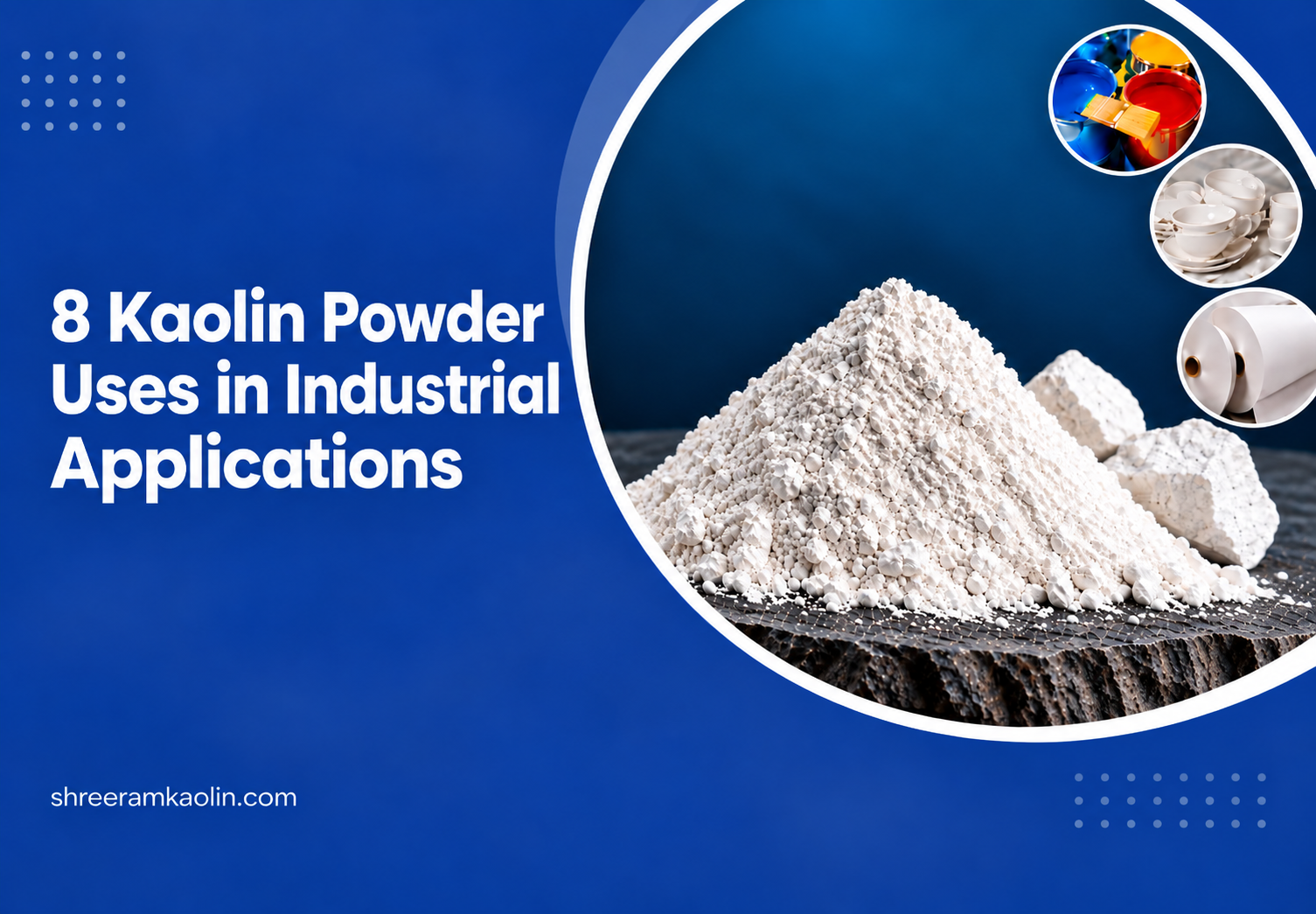
Kaolin powder is a soft white clay mineral with very fine particle size, chemical inertness, and whiteness, which is used in various industries. It is mainly used in the manufacture of paper, ceramics, paints and coatings, plastics and rubber, wastewater treatment, catalysis, and cable insulation.
Kaolin powder is likely something you haven’t given much thought to, but it has been used in almost every facet of today’s manufacturing. This is a fine, white clay mineral that is extracted from global deposits and has, almost unnoticed, become one of the most versatile raw materials used in the industrial production.
Whether it’s in a glossy magazine or the ceramic mug sitting on your desk, the role of kaolin in everyday products is secondary. It has a chemical stability, a fine particle structure and a natural whiteness that make it of great value beyond belief.
In this guide, the top 10 industrial applications of kaolin powder are explained in detail, and the reasons why various types of manufacturers are using it. So whether you’re looking for raw materials to use in your own productions, or just interested in the science of everyday objects, you will leave with a greater understanding of why this little mineral is so important.
What is kaolin powder made of?
Kaolin powder is mainly composed of kaolinite, which is a hydrated mineral of aluminum silicate with the chemical formula Al2Si2O5(OH)4. It is a product of weathering of rocks that contain a high concentration of feldspar, such as granite, and takes thousands of years to form. This makes it a soft, fine-grained, naturally white to near-white clay that is one of the most desirable qualities in clay for manufacturing.
The particle structure of kaolin is thin, plate-like crystals which give properties to it that other clays do not possess. It is easily dispersed in water, does not react with most materials and is heat resistant. These properties are the reason for the many industrial applications of kaolin.
Top 08 Industrial Uses of Kaolin Powder
1. How does kaolin powder improve paper manufacturing?
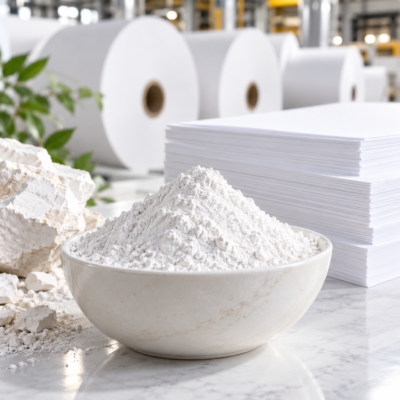
Kaolin is also an essential material in forming paper to be smooth, bright and acceptable for printing. There are two primary applications of kaolin by paper manufacturers: inside the paper sheet, and on the surface.
Kaolin is used as a filler to fill the voids between wood fibers in the resulting sheet for uniformity. This reduces the amount of wood pulp required, thus reducing material costs and environmental impact. When used as a coating, kaolin particles produce a smooth and shiny finish perfect for print, for magazine pages or glossy marketing brochures.
Print clarity and image sharpness are more important than cost; use kaolin-coated paper; use uncoated, kaolin-filled paper for general office printing where smoothness is not as important.
2. Why is kaolin used to strengthen fiberglass and insulation?
Kaolin powder is used as reinforcing material of fiberglass and insulation products. Kaolin improves mechanical properties, heat resistance, chemical resistance and reduces curing shrinkage when added to fiberglass composites.
Kaolin is a good barrier material that has low thermal conductivity in insulation materials. Kaolin is also added to insulation batts and boards to improve fire resistance, while retaining the lightweight nature of the product. This is particularly critical when it comes to construction and the automotive industry, where lightweight and heat-resistant properties are essential.
3. What makes kaolin the backbone of the ceramic industry?
Kaolin is the most important raw material for the ceramics industry. In addition, the clay is enhanced with kaolin for its plasticity to form wet clay into bowls, tiles, sanitaryware, and decorative pieces and also adds to the final product’s whiteness and strength after firing.
Kaolin undergoes a change during the firing process, becoming hard vitreous material which does not crack and keep its shape at high temperature. That’s why kaolin is a key component of porcelain, stoneware and fine china. Kaolin would not be present in such large quantities without it being used by manufacturers to produce a smooth, white finish for the premium ceramic products.
Kaolin is not only used for its aesthetic appeal, but also for its ability to impart strength to finished products, which is essential for pottery studios and large ceramic factories.
4. How does kaolin boost house paint and coating efficiency?
Kaolin is used by paint companies in both water-based and oil-based paints as an opacifier, cost reduction and to improve the application properties. Kaolin is used as an extender pigment; it enables the use of less expensive titanium dioxide pigment for good coverage.
Kaolin also enhances the flow and leveling properties of paint, ensuring a smooth and even application on walls and surfaces. Kaolin is used in exterior coatings for its weather resistance and ability to resist cracking or peeling over time.
This is because paints containing kaolin typically provide superior coverage per gallon, which represents a cost savings to the home-owner and/or contractor on larger jobs.
5. Why are plastics and rubbers reinforced with kaolin?
In plastic and rubber industry, Kaolin is used as functional fillers, to enhance mechanical properties such as tensile strength, stiffness, and wear resistance. Kaolin is used to control viscosity during processing of rubber products like tires, hoses, conveyor belts and also to reduce production costs.
In plastics, the calcined kaolin, which is heat-treated to remove chemically bound water, is especially useful. It can increase the electrical insulating properties and resistance to moisture and chemical breakdown. This makes kaolin-filled plastics a popular choice for cable sheathing, automotive parts, and industrial piping.
6. Can kaolin act as a clean up agent for the environment?
The absorbent properties of Kaolin further extend to the environment. It is very fine grained, and the chemistry of its surface ensures that it will attract heavy metals, oils, and other soil and water pollutants, making it useful in pollution control and wastewater treatment.
Kaolin-based absorbents are used in oil spill cleanup operations to absorb and contain spilled petroleum products and limit the spread and environmental damage caused by the oil spill. Kaolin is also used in water treatment plants to help clarify water by adsorbing suspended particles to aid in easier filtration.
7. How does kaolin serve as a catalyst in chemical manufacturing?
In chemical production, calcined kaolin or heat treated (metakaolin) kaolin is used as a catalyst in a number of chemical reactions such as oil refinery petrol cracking processes.
The high surface area and thermal stability of kaolin ensures that it can be used as a catalyst carrier that will not decompose at high temperatures. This application is not seen by consumers but is an important, behind-the-scenes process for the manufacture of fuels and chemical products that consumers use daily.
8. Why is kaolin used for insulating cables and wires?
Kaolin is used as an insulating filler in the protective sheathing of electrical conductors made by cable and wire manufacturers. The electrical resistivity properties of kaolin prevent current leakage and the chemical stability of the insulating properties can withstand the use of years in harsh environments.
In particular the use of calcined kaolin with a low moisture content and minimal effect on the electrical properties of the surrounding polymer is preferred here. This makes it a reliable resource for residential wiring and in heavy-duty industrial cable applications as well.
Shree Ram Kaolin: Quality Kaolin Solutions for Multiple Industries
Discover the versatility of kaolin powder with Shree Ram Kaolin. From ceramics and paper manufacturing to paints, rubber, plastics, and industrial insulation, kaolin plays an essential role in numerous applications. Explore the top 08 industrial uses of kaolin powder and learn how its natural whiteness, fine particle structure, and chemical stability support diverse manufacturing needs. Visit Shree Ram Kaolin to learn more about kaolin solutions for various industries.
Why kaolin remains essential across industries
While it may be a powder particle that doesn’t get a lot of attention, it’s an enormous array of products in your home that you use every day that feature kaolin. Owing to its specific combination of chemical stability, whiteness and fine particle structure, it is virtually impossible to replace this product in every industry from chemical manufacturing.
With its versatility and reliability in use, kaolin is expected to be a continued source of raw materials for many years. However, when selecting materials for manufacture or product development it is important to be familiar with the specific grades of kaolin and the various processes available such as calcination.

