
Levigated China Clay: Uses, Properties, Composition and Industrial Specification
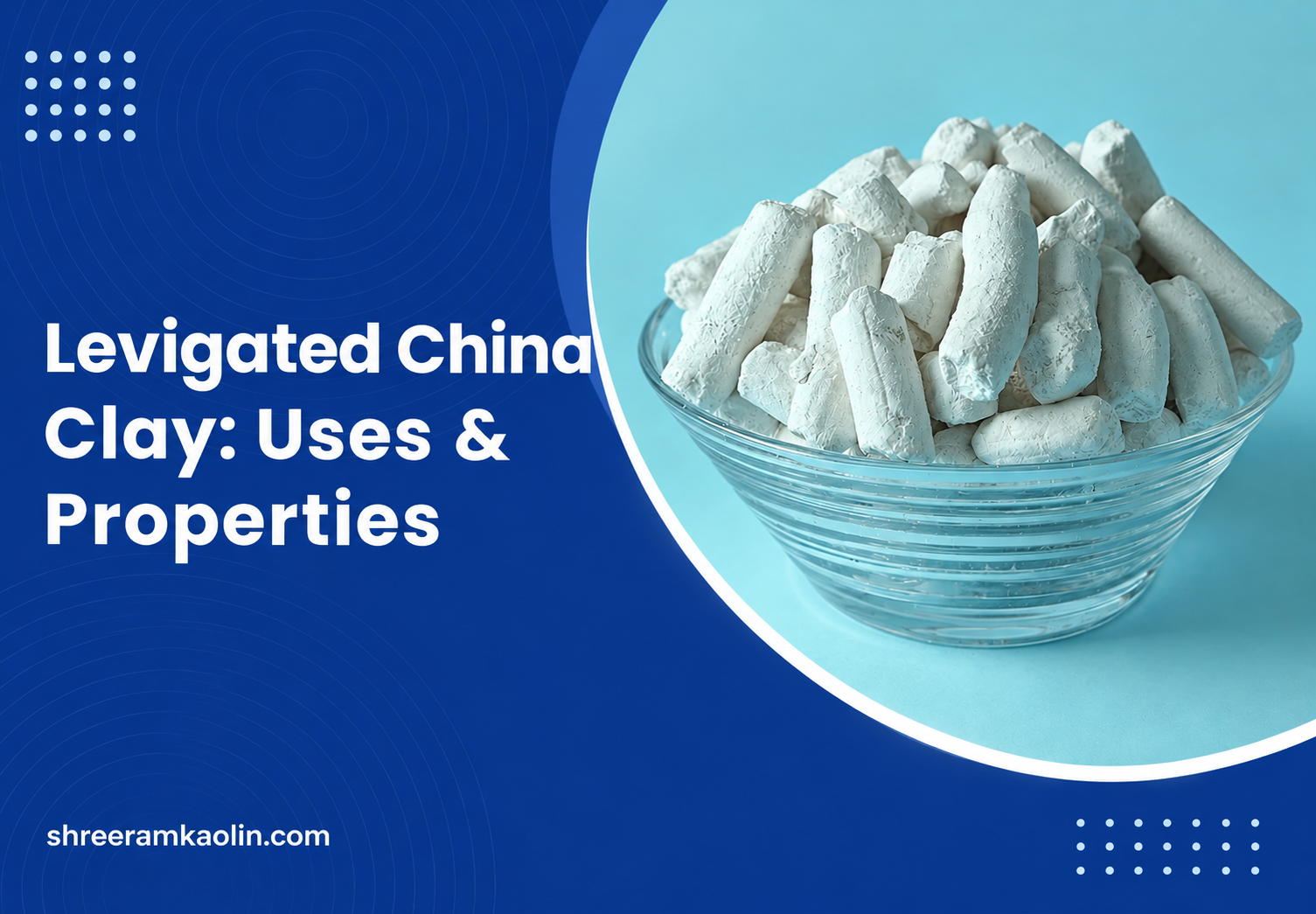
Levigated china clay is a purer, water processed, china clay which has been cleaned from coarse particles, grit and impurities. Its fine particle size, bright whiteness and chemical stability make it desirable for use in a wide variety of applications ranging from glossy paper and fine ceramics to cosmetics and pharmaceuticals. This is probably the clay you need if you are in a industry that requires a reliable, high-purity-filler or coating material.
Ever put your fingers to a piece of shiny magazine paper and thought to yourself, what makes this paper so smooth, so silky under my fingers? Or, saw a white ceramic mug and thought nothing of the fact that such a whiteness is made possible by it. It’s highly likely that China clay was used in the process of levigation.
It is a simple mineral with a powerful impact in more than a dozen industries. It’s not flashy. It never makes itself known. Trace back the paper-making, ceramics, rubber, cosmetics and even the pharmaceuticals and you’ll see this pristine clay at work.
But what exactly is levigated china clay and what is its importance to manufacturers all over the world? Let’s take a stroll together from its manufacture to its composition to the point where it ends up in your daily products.
Introduction to Levigated China Clay
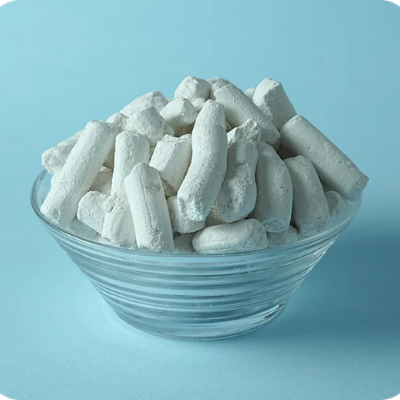
Raw kaolin can be like an unpolished gemstone. It’s useful, but not quite ready for prime-time. That raw material is then subjected to levigation, the polishing process that renders it purer, finer and much more useful.
Levigated china clay is one of the most useful industrial minerals ever. It is quietly supporting paper brightness, ceramic strength, rubber reinforcement, paint consistency, cosmetic texture and pharmaceutical formulation. It’s sort of like flour for baking where sometimes you don’t realize you need it, but then without it, nothing comes together.
Let’s take a closer look at the nature of levigated china clay, its manufacturing process, its characteristics and the application areas in which it shines.
What Is Levigated China Clay?
Levigated china clay is a refined and fine-grained version of kaolin, a naturally occurring clay mineral that is primarily made up of the mineral kaolinite. The term “levigated” is used for the particular separation process employed to extract the finer and more valuable particles from the coarser and less desirable material. Imagine a chef taking flour and sifting it to eliminate the lumps and obtain that “smooth” consistency needed for baking. Clay is purified in a similar way with levigation; it results in a finer and more consistent product.
The Levigation Process Explained
The levigation process is a separation process by water. Raw kaolin clay is slurried, almost like a thin mud soup, with water. This mixture is then left to settle, or passed through a number of controlled flows and tanks.
This naturally separates the clay because of the effect of particle size on the speed of sedimentation in water. Coarser particles, heavier particles, and grit, sand, and mineral impurities such as mica or quartz settle in the bottom. The smaller, more refined kaolinite particles remain in suspension for a longer period of time and are separated out.
The result? A clay of exceptional purity, fineness and absence of gritty impurities which would hamper its suitability for the manufacturing process.
How It Differs from Raw Kaolin
Raw Kaolin is a lot of mixed things. Yes, it does have kaolinite, but also quartz, feldspar, mica, iron oxides and other minerals which can impact color, texture and performance. Not the ideal choice for high precision industrial uses.
Levigated china clay has been through that refining process. It is whiter, finer and much more uniform from batch to batch. Raw kaolin is the water straight out of the river while levigated china clay is the filtered, bottled version – cleaner, safer and ready to use where quality cannot be left to chance.
Chemical Composition of Levigated China Clay
Understanding what’s actually in this clay helps explain why it performs the way it does across such a wide range of industries.
Primary Minerals and Elements
Raw kaolin can be like an unpolished gemstone. It’s useful, but not quite ready for prime-time. That raw material is then subjected to levigation, the polishing process that renders it purer, finer and much more useful.
Levigated china clay is one of the most useful industrial minerals ever. It is quietly supporting paper brightness, ceramic strength, rubber reinforcement, paint consistency, cosmetic texture and pharmaceutical formulation. It’s sort of like flour for baking where sometimes you don’t realize you need it, but then without it, nothing comes together.
Let’s take a closer look at the nature of levigated china clay, its manufacturing process, its characteristics and the application areas in which it shines.
Role of Kaolinite in Its Composition
It’s kaolinite that literally tops the list here. Levigated china clay has an excellent coating ability, smooth texture and softness due to its layered crystal structure (thin, plate-like particles stacked much like pages in a book).
This layering is also the key to clay’s high filler/exteeder properties. The particles can align and fit together tightly, enhancing qualities such as opacity, smoothness, and strength in the final product, such as a paper sheet or a tube of toothpaste.
Physical and Chemical Properties
What makes levigated china clay so prized across industries isn’t just its composition it’s how that composition translates into usable, measurable properties.
Particle Size and Texture
The major benefit of levigation is that the particle size is controlled. This process usually produces a particle size range of 1 to 10 microns although, depending on the application, there are grades available for finer particle sizes.
This smooth and uniform particle size make the clay to have a smooth almost silky texture. This is why it’s used to coat a surface evenly, blend it into formulations and not give them a gritty texture like coarser minerals would.
Whiteness and Brightness
So if you’ve ever had two pieces of paper side by side and seen one of them looked brighter in colour and crisp than the other, then there’s a high chance that it was due to the clay quality. The levigated china clay is highly sought after because of its brightness and whiteness, which is largely due to the removal of impurities such as iron oxide during the refining process.
The brightness is usually standardized and measured by a numerical scale (usually a percentage, higher numbers representing brighter, whiter clay). In paper manufacturing, cosmetics and other industries, manufacturers pay careful attention to this measurement because even slight changes in brightness can impact the finished product.
pH and Chemical Stability
Levigated china clay is generally chemically inert and stable, and has a near neutral pH of about 4.5 to 7.5 (depending on source and processing). Its stability is a primary reason for being used in sensitive applications such as pharmaceutical and cosmetic applications where unwanted chemical reaction is not acceptable.
It is also a good, consistent ingredient that manufacturers can count on from batch to batch because it doesn’t interact with most acids and alkalis and other chemicals.
Industrial Specifications of Levigated China Clay
Not all levigated china clay is created equal. Different industries have different needs, which means manufacturers produce multiple grades tailored to specific performance requirements.
Standard Grades and Classifications
Grading is usually based on distribution of particle size, brightness, oil absorption, and viscosity. The following is a broad guideline of the most common classification of grades that is found, although the details vary by supplier and region.
| Grade Type | Typical Characteristics |
| Paper Grade | Fine particle size, high brightness, optimized for coating and filling |
| Ceramic Grade | Controlled plasticity, moderate particle size, consistent firing behavior |
| Rubber Grade | Reinforcing particle structure, good dispersion properties |
| Cosmetic Grade | Ultra-fine particle size, high purity, skin-safe formulation |
| Pharmaceutical Grade | Extremely high purity, strict contaminant limits |
How Industries Define Quality Parameters
But quality is not only a matter of appearance it’s determined by a variety of technical parameters. The latter are frequently particle size distribution (PSD), brightness percentage, moisture content, pH and oil absorption rate.
Impurity levels are also a concern for industries, as even low levels of impurities can have an impact in very sensitive applications such as pharmaceuticals and cosmetics. Many manufacturers test to known methods to assure consistency from batch to batch, a factor that is important to a manufacturer who depends on a material for consistent performance.
Uses of Levigated China Clay
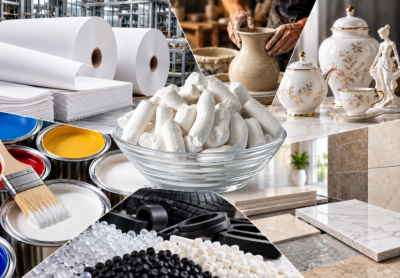
This is where things get interesting. Levigated china clay isn’t a one-trick mineral it shows up in an impressively wide range of industries, each one leaning on a different combination of its properties.
Use in the Paper Industry
It is no surprise that levigated china clay is one of the biggest users of levigated china clay; the paper industry is one of them. It’s used for two things: firstly, to help in the filling so that there is less woodpulp used in the product; and secondly, to give product that smooth and shiny surface that you see on magazines and good quality print products.
Consider the differences between a newsprint page and a glossy cover for a magazine. That texture and brightness difference? Clay coating is playing a significant role.
Use in Ceramics and Pottery
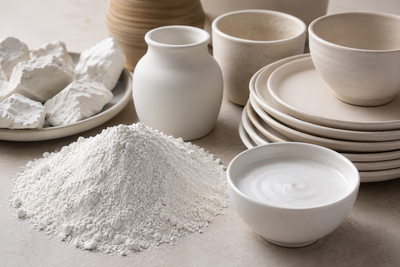
In ceramics, levigated china clay can be used to improve the plasticity and workability of the clay and to give the best white finish in fine porcelain and tableware. It is a favorite among potters and manufacturers for its retaining strength when forming and firing to a clean, strong finish.
It’s sort of like the difference between using hard, inflexible dough and soft, pliable dough clay is refined so as to provide increased control and consistency to the artisan.
Use in Rubber and Plastics
Levigated china clay is used as a reinforcing filler in rubber industry to enhance tensile strength, abrasion resistance, and overall durability. It’s also used in plastics to make them stiffer, but without compromising performance or reducing production costs.
Use in Paints and Coatings
This clay is used as an extender pigment by painters. It aids in controlling viscosity, coverage and creates a more even and smooth finish. It also helps in reducing amount of expensive pigments required, which is beneficial for both performance and cost effectiveness.
Use in Wall and Floor Tiles
China clay used to manufacture wall and floor tiles for improving plasticity, workability and surface finish is known as levigated china clay. It can be used to hold the shape of the tile during forming, to aid whiteness, and to ensure the production of strong and durable ceramic tiles.
Use in Porcelain
Levigated china clay has a fine particle size, high purity and whiteness and is therefore extensively employed in the manufacture of porcelain. It enhances the plasticity, strength and smoothness properties and results in very hard, white and translucent porcelain products with a nice fired appearance.
Environmental and Safety Considerations
Responsible sourcing and handling is as important in the case of any industrial mineral. Although it is a water-intensive process, many kaolin producers are beginning to make the effort to use more sustainable methods to extract and recycle water when processing kaolin, as part of the mining process.
Levigated china clay is safe to handle, in general, from a safety perspective. However, long-term inhalation of dust is not recommended and the use of standard industrial safety measures, such as adequate ventilation and dust protection, during handling and processing is recommended as with most fine mineral powders.
Trusted Levigated China Clay Manufacturer & Supplier : Shree Ram Kaolin
Looking for high-quality Levigated China Clay in India? Shree Ram Kaolin offers premium-grade Levigated China Clay processed to deliver excellent whiteness, purity, plasticity and consistent quality. Our refined china clay is suitable for various industrial applications, including ceramic tiles, sanitaryware, porcelain and other ceramic products. With advanced mineral processing facilities and a strong commitment to quality, we aim to meet the diverse requirements of industrial manufacturers. Choose Shree Ram Kaolin as your trusted Levigated China Clay Manufacturer for reliable products and consistent performance.
Bringing It All Together
While levigated china clay may not be the subject of much outside attention, its marks are all over the surface of a remarkable array of consumer goods. Whether it’s reading paper, drinking from a ceramic mug, painting walls, or applying cosmetics to your face, this refined clay performs flawlessly, industry after industry, batch after batch.
When ordering materials for production, it’s important to know the grade, particle size and purity required. Different applications require different specifications, and collaborating with a reputable supplier with a good understanding of your industry’s needs could be the key.

