
What are the uses of clay soil
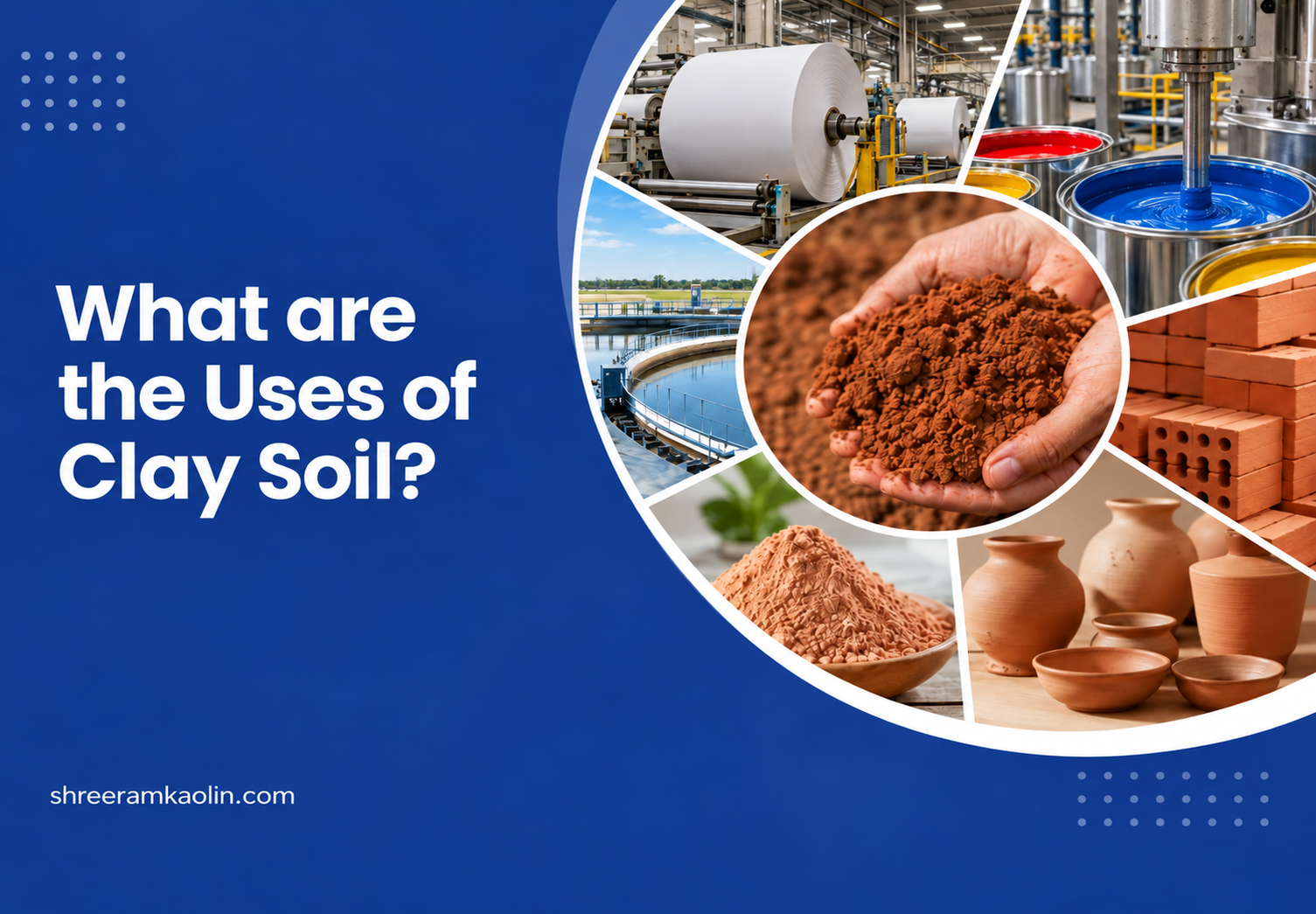
Clay soil is a valuable resource in agriculture; construction; ceramics and pottery; and other industries. It is used for many things due to its fine particles, water holding ability, plasticity and mineral contents. Clay soil is essential for many products that are important to people: keeping water in farmland, making bricks, ceramic tiles, paper and paints.
Clays vary in terms of properties and suitability for specific applications. Kaolin, for instance, is utilised in the ceramic and paper industries, while bentonite is important for its properties as a binder in foundry processes. The knowledge of uses of the clay soil guide the farmers, manufacturers and industrial buyers to choose the suitable material for them.
In this article, we will discuss the main applications of clay soil, its characteristics and significance in various industries.
What Is Clay Soil?
Clay soil, soil which has a large content of fine mineral particles (usually less than 0.002 mm in diameter). These particles pack tightly which enables the clay soil to hold water and nutrients. It is sticky and mouldable when wet and hard and compact when dry.
Weathering of rocks and geologic processes are the source of clay minerals. The common clay minerals are kaolinite, illite and smectite. The properties of the individual minerals affect the plasticity, moisture-holding ability, shrinkage and chemical activity of the soil.
Clay is a versatile material that can be used in a wide range of other applications. Clay materials are also the essential raw material for manufacturing industries after being processed. The quality and performance varies according to the mineral composition, particle size, purity and processing methods.
10 Common Uses of Clay Soil
1. Uses of Clay Soil in Agriculture
Water and nutrients are important characteristics of clay soil for agriculture. With the proper management of these characteristics, plants can be supported.
Water holding ability: Fine clay particles retain water that is available to plants between rains or waterings. The danger of waterlogging if drainage is not adequate, however, is a problem if moisture is excessive.
Nutrient retention: Many clay minerals are able to retain calcium, magnesium and potassium. This may help to preserve soil fertility and prevent nutrient loss.
Soil improvement: In some sandy soils, moisture-holding clayey materials may be added to improve the soil. But if the soil is too clayey, it may compact too much and soil type should be identified prior to amendments..
2. Clay Soil in Brick Manufacturing
Clay is a natural raw material used for making construction blocks in the past. It is very plastic and can be molded into uniform blocks prior to drying and firing.
Most of the manufacturing process consists of mixing clay with water, shaping, drying, and firing in a kiln. Firing creates strength and durability of construction.
Clay colour, shrinkage, strength and damage resistance is influenced by the quality of the clay. Depending on its mineral composition, workability and firing properties, manufacturers choose the appropriate clay..
3. Clay Soil in Ceramic Manufacturing

Clay is used in a large amount of ceramic productions due to its ability to become shaped into various forms, and to gain useful properties when fired. These are used in ceramic tiles, sanitary ware, tableware, pottery and decorative items.
Kaolin, or china clay, is a very important mineral for many ceramic formulations due to its mineral content, whiteness and firing properties. Other clays may provide good plasticity and workabilityaolin
Clay is mixed with other raw materials, formed, dried and fired at controlled temperature during production. Choosing appropriate clay can ensure that the manufacturers produce quality and consistent products, dimensional stability and desired surface appearance.
4. Clay Soil for Pottery and Handmade Products
Clay has been utilized for making handmade items and pottery for centuries. If mixed with water the right clay can be formed into a suitable product or decoration.
They are commonly used in cooking pots, bowls, cups, vases, sculptures, and traditional earthenware. Clay is selected for its workability, shrinkage, firing temperature and finished colour.
To avoid cracking, deformation and other defects, it is essential to have thorough drying and firing procedures. Each body will give a specific type of pottery and type of pottery piece.
5. Clay Soil in Cement and Construction Materials
Clay-bearing materials are important source of the silica, alumina and other constituents, which are needed in the conventional cement manufacturing process. The combination of these materials with limestone and other raw materials is done to make cement clinker at high temperatures.
Some processed clays are also used in the production of supplementary cementitious materials. For instance, when properly calcined, kaolinitic clay may show pozzolanic properties and help to make the cementitious properties.
Clay is suitable for building materials depending on the chemical composition, mineralogy, processing conditions and technical properties of the built product.
6. Clay Soil in Paper Manufacturing

Kaolin is used in paper-making as a filler and coating pigment. It has optical and fine particles properties which can be used in paper to enhance its appearance and surface properties.
Key benefits include:
Smoothness: helps to create a more even paper surface.
- Opacity: Helps improve the hiding power of paper.
• Printability: Contributes to surfaces suitable for printing.
Appearance: Can brighten and achieve uniformity of the surface in appropriate formulations.
Depending on the particle size, brightness, purity and end use of the paper, paper manufacturers choose suitable grades of clay.
7. Clay Soil in Paints and Coatings

In paints and coatings, a functional filler/exducer used in clay minerals is a functional extender. They have the capacity to modify the texture, opacity, surface finish and formulation consistency, depending on its property.
Selected modified clay materials can also offer thickening and/or suspension properties, and kaolin can be used to help improve pigment dispersion and surface appearance.
Architectural, decorative, and some industrial formulations, as well as architectural and decorative coatings, use clay-based materials. They will only perform as intended if the size of the particles, the way they are treated on their surface, their compatibility with the other ingredients, and the desired properties of the coating itself are suitable for them.
8. Clay Soil in Foundry Applications
Some of the clay materials, particularly bentonite, are of significant importance in foundry processes. One of the most common applications of Bentonite is in the casting of metals, as a binder in green sand moulding systems.
It is used in conjunction with appropriate sand and water to help hold the sand particles together and keep the shape of the mould while casting.
The primary applications are to strengthen the mould, aid in moulding retention and to assist in moulding sand re-use. The selection of clay binders depends on their bond strength, moisture and thermal properties.
9. Clay Soil in Environmental Applications
Selected Clay Minerals also have low permeability and/or interact with selected dissolved substances, thus making them suitable for use in Environmental Management.
The applications include landfill liners, pond sealing, engineered containment barriers, and some wastewater treatment processes. Appropriate compacted clay can be used to reduce water flow and appropriate clay can be used to retain specific contaminants.
Testing and engineering must be carried out for these applications. Not all clay soils possess permeability, chemical compatibility and stability required for protection of the environment.
10. Clay Soil in Cosmetics and Personal Care
Some types of clay are applied in cosmetics, personal care products and as facial powders.
Kaolin is used for its fine texture and absorptive properties for surface oil. It can help to improve the consistency of a product along with giving a smooth feel, depending on formulation.
Grades suitable for use in personal care products should only be used after proper processing. The purity and contaminant levels as well as applicable product safety requirements should be taken into account.
Important Properties of Clay Soil
The properties of clay determine its suitability for different applications.
| Property | Importance |
| Fine particle size | Influences surface area and processing behaviour |
| Plasticity | Helps clay retain its shape during moulding |
| Water retention | Supports moisture management in soil |
| Mineral composition | Affects chemical and firing characteristics |
| Whiteness | Important in ceramics, paper, and selected coatings |
| Purity | Influences suitability for specialised applications |
| Shrinkage | Affects drying, shaping, and firing quality |
Understanding these properties helps manufacturers choose appropriate clay materials and achieve more consistent production results.
Conclusion
In agriculture, clay soil is used for growing crops, in brick making, ceramics and pottery, cement, paper, paint, foundries, environmental management and cosmetics. It is a valuable natural material due to its fine particle size, plasticity, moisture retention and mineral composition.
But, the properties of clay vary from use to use. The correct type of clay depending on the clay chemistry, quality and application properties can help to enhance manufacturing consistency and the overall performance. By grasping these features, farmers, builders, and manufacturers can choose the appropriate material for their applications, ensuring a more successful outcome.

