
How Is Glass Made From Sand

Take a look through the window. Sip from your clear glass bottle. Or check your screen. Glass is a material you interact with constantly. Have you ever wondered where the smooth transparent material came from? Most people are surprised to learn that glass begins as sand.
Glass is indeed made of sand. It sounds magical to transform tiny grains of sand in to a clear, solid sheet of glass. It involves an exact mix of extreme heat and chemistry.
For high-quality glasses, the manufacturers depend on a certain material.
The Role of Silica Sand

Quartz sand is also called silica. The glass’s basic structure is created by this specialized sand. Silica’s properties allow it to melt, reform and become a solid without crystallizing. This is important because, if it crystallizes into an opaque material instead of the glass that we require, the result will be a clear solid.
Why Purity Matters
For perfect clarity in the glassmaking process, silica must be very pure – often exceeding 98% silica. The removal of unwanted materials is done through specialized mining and washing techniques. Glass that contains iron, or any other contamination will turn green or brown. It may also lose structural integrity. The final product must be pure to remain strong, durable and transparent.
Key Ingredients for Making Glass
Silica Sand is the main ingredient, but it can’t do everything. The process of melting pure silica is difficult and costly because it requires extremely high temperatures. Manufacturers use the so-called “soda lime” recipe to solve this issue.
The four major ingredients of standard glass are:
- Silica Sand (70%): Provides core structure and clarity.
- The Soda Ash (15%) Reduces the melting temperature of sand and saves massive energy.
- Calcium (10%): Strengthens. Limestone acts as a stabiliser because soda ash dissolves glass in water.
- Recycled glass (Cullet). Accelerates the melting process. The use of old glass makes the melting process faster and easier.
Step-by-Step: How Sand Becomes Glass
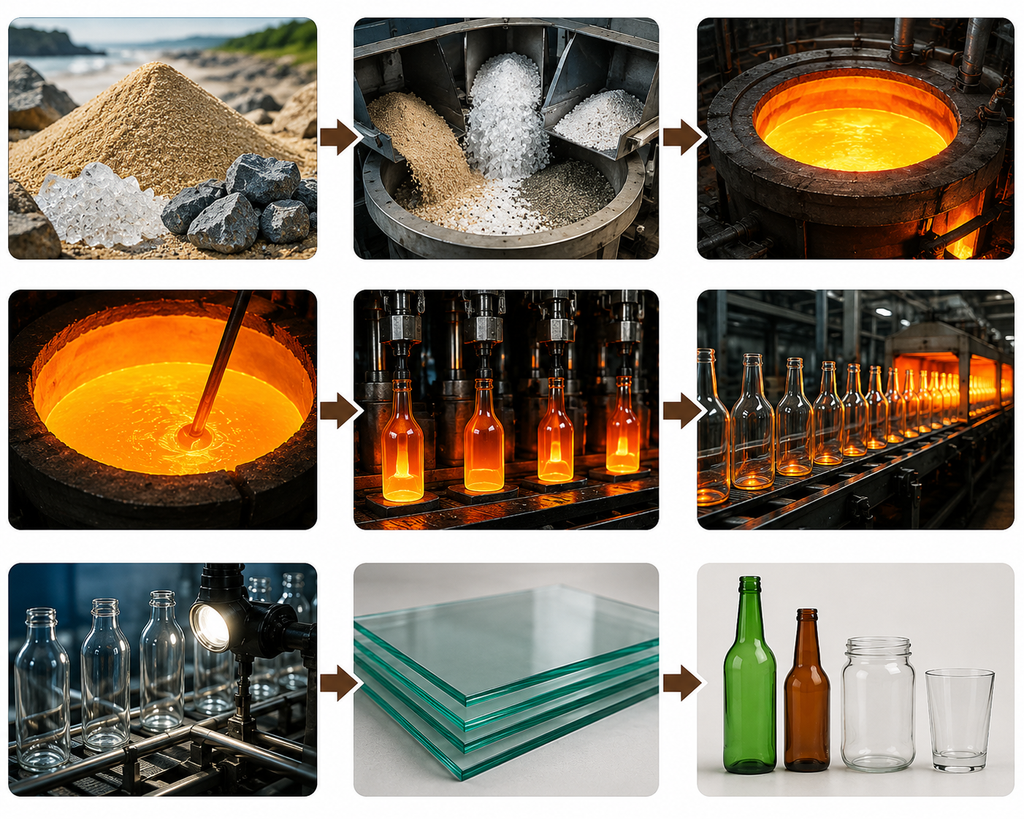
To turn a stack of raw materials in to a window pane that is pristine, you need a multi-staged operation. This is the process for making glass from sand.
Step 1: The final step is to mix the batch
Workers must accurately measure all ingredients before applying heat. The silica, limestone, limestone and soda ash are weighed to precise proportions. A massive mixer mechanically blends all the ingredients together once they have been weighed. A uniform distribution will ensure that the glass melts consistently and without any weak areas.
Step 2: Melting the metal in the furnace
This mixture is then melted in an industrial furnace. Here is when the transformation takes place. The batch is heated to an incredible 1700degC (3092degF) in the furnace. The solid minerals and sand melt at this temperature to form a liquid that is orange in colour.
Step 3: Removing bubbles
During the melting process, liquid glass will naturally hold air. The glass will appear cloudy and weak if it cools down with bubbles in the interior. The molten glass must be kept in a zone of high heat to fix the problem. This heat is sustained, allowing trapped air and gases to escape. The final product will be transparent thanks to this step.
Step 4: Shape the glass
It is now time to shape the liquid glass once it has become clear and free of bubbles. It is entirely up to you what shape the glass will take.
- To make flat glass windows, The manufacturers pour the liquid tin into a shallow large bath. Glass floats over the liquid tin and spreads out to form a flat sheet.
- To make bottles and jars, machines drop liquid glass into molds. The glass is pressed against the wall of the mould by a blast of compressed air.
- Plates and bowls: The heavy mechanical plungers are used to press molten glass in pre-formed molds, forming durable glassware.
Step 5. The Annealing Process
It is not possible to leave glass at room temperature for it to cool. Glass that cools down too fast shrinks more on the outside than it does inside. The glass will shatter immediately if the internal pressure is too high.
To prevent this, the shaped glass travels slowly through a long, temperature-controlled oven called a “lehr.” The temperature is gradually lowered in the oven over a period of several hours, or days. The annealing process, which is a slow and even cooling procedure, removes the internal stresses of the glass.
Mistakes that are common in the glass manufacturing process
Quality control is essential, even with the most advanced technologies. Some common mistakes can ruin a batch.
- If you use low-purity glass sand, you can skip the purification process.
- Temperature control incorrect: The sand won’t melt if the furnace temperature is set too low. Equipment can be damaged if it gets too hot.
- Speeding up the cooling process: The result is almost always cracked glass or very brittle, which fails the inspection.
Discover Premium Silica Sand for Superior Glass Quality
If you’re looking for high-quality silica sand for your own glass production or any industrial project, consider exploring the options at Shree Ram Kaolin. Their premium silica sand helps ensure your final product is clear, strong, and up to the highest standards just like the glass you trust every day.
Conclusion
Next time you gaze through a glass window, know that it has been a long journey. The glass is created from sand. But it takes a blend of limestone and soda ash, as well as a high-purity silica.
This process makes it clear how important quality raw materials are in the manufacturing industry. Take a look at the different grades of silica available in the marketplace and how these affect the products that you use each day.

