
Where Is Kaolin Clay Found?

Kaolin is located in the tropical and subtropical areas where rainfall, heat and temperature have been causing granite to break down over many millions of years. India, China and Brazil are the top producing countries, followed by parts of Europe, Africa and America (Georgia). India has estimated reserves of 986 millions tonnes ball and china clay.
Kaolin clay will be on your radar if you are a manufacturer of paper, ceramics or paints. It may also appear in cosmetics and pharmaceuticals. The soft white mineral improves the overall quality of many everyday products. To source it correctly, you need to know where the mineral comes from and why certain deposits are superior. You also have to be aware of which areas offer the best supply.
The guide explains where the kaolin is located around the world, how India became a major industrial buyer, and the formation of the mineral. You’ll be able to see the global map of kaolin and make better sourcing decisions.
What is kaolin clay?
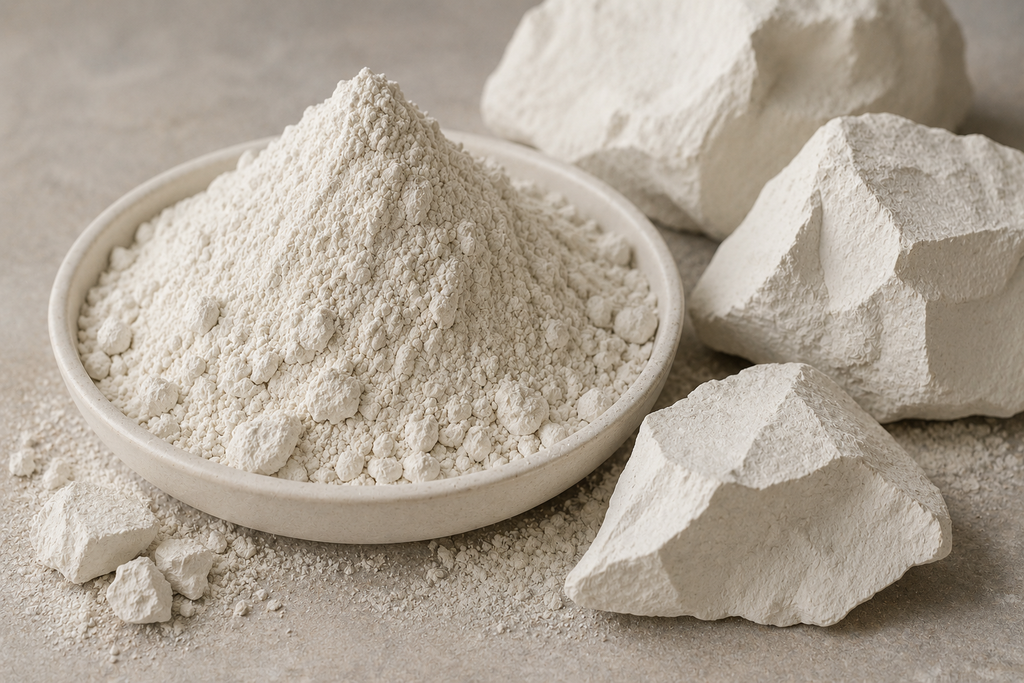
The mineral kaolin, or china clay as it is also known, has a soft texture, and is usually white in color. The chemical formula of kaolinite is Al2Si2O5 (OH)4 and it’s an aluminum silicate.
Kaolin is chemically gentle and inert because it has a pH of neutral. This single characteristic explains its use in everything from skincare masks and antacid medications to glossy magazines. It brightens and smoothes the surface of materials without causing any reaction.
Where is kaolin clay found around the world?
Kaolin is found on almost every continent. However, a few regions are the largest producers. This is a brief tour of major kaolin producing areas.
Asia Pacific: India, China and Australia
In 2024, the Asia-Pacific region will contribute the largest share to the global market for kaolin. India, China and Australia are the top two producers of kaolin. India is a major source of deposits for industry buyers due to its size and growing export infrastructure.
North America: the United States and Canada
Georgia, in the United States is undisputedly the kaolin capitol. Georgia is responsible for 94% of the total US production of kaolin, and the city of Sandersville has been nicknamed the “Kaolin Capital of the World.” Georgia produces more than eight million tons of kaolin per year, according to the US Geological Survey. Canada contributes smaller quantities to North American supplies.
Europe: Germany, the UK, France, and Spain
Europe’s kaolin history is long. China clay has been produced in Cornwall, United Kingdom, for many centuries. Germany, France and Spain also have active deposits, which feed Europe’s paper and ceramic industries.
South America: Brazil
Brazil has large reserves of kaolin, especially in the northern region near Amazon Basin. The deposits, which are highly prized because of their brightness, are used for coatings and paper.
Africa: South Africa and Nigeria
South Africa and Nigeria have significant deposits of kaolin. These reserves will likely attract additional investment as industrial demand increases across Africa.
Where Are The Major Kaolin Clay Deposits In India?
India has the largest reserves of kaolin in the world. It holds an estimated total of 986 millions tonnes. These deposits are still largely untapped and give India room for growth.
These numbers are a testament to this. By 2030, the Indian kaolin industry is expected to grow at a rate of compounded annual growth of 5%. This means that buyers can plan long-term production without worrying about a shrinking supply.
India’s deposits are located in several different states. The major deposit locations are listed below.
Gujarat : the strategic location for sourcing
Gujarat is the top industrial buyer in India, and with good reason. Kaolin is a mineral that’s used in the manufacture of ceramics, rubber, paper and paint. Districts like Kutch, Bhavnagar are located near international ports and have excellent road connections.
This proximity is important. Gujarat suppliers can help you to avoid shipping and production delays if you are importing or manufacturing kaolin for export. Gujarat is a good place to begin for most international buyers.
Rajasthan : high-alumina, low-iron clay
Kaolin from Rajasthan is known for its quality–specifically a low iron content and a higher percentage of alumina. The most productive mines are located in Chittorgarh and Bhilwara. The cement industry is one of the largest buyers of this clay..
West Bengal : ceramics and paper supply
West Bengal kaolin is mainly mined in the Bankura and Birbhum districts. Clay extracted in this region is mainly used by ceramics and papers manufacturers.
Karnataka : ceramics, paper, and paint
Karnataka’s Mysore district and hassan district contribute. Kaolin is used in the paper and paint industry.
Odisha : untapped potential
Kaolin can be found in Odisha around the Mayurbhanj, and Sundargarh district. Although the industry is not fully developed, it has great potential. This region has the potential to contribute significantly more to India’s production with proper investment.
How is kaolin clay formed?
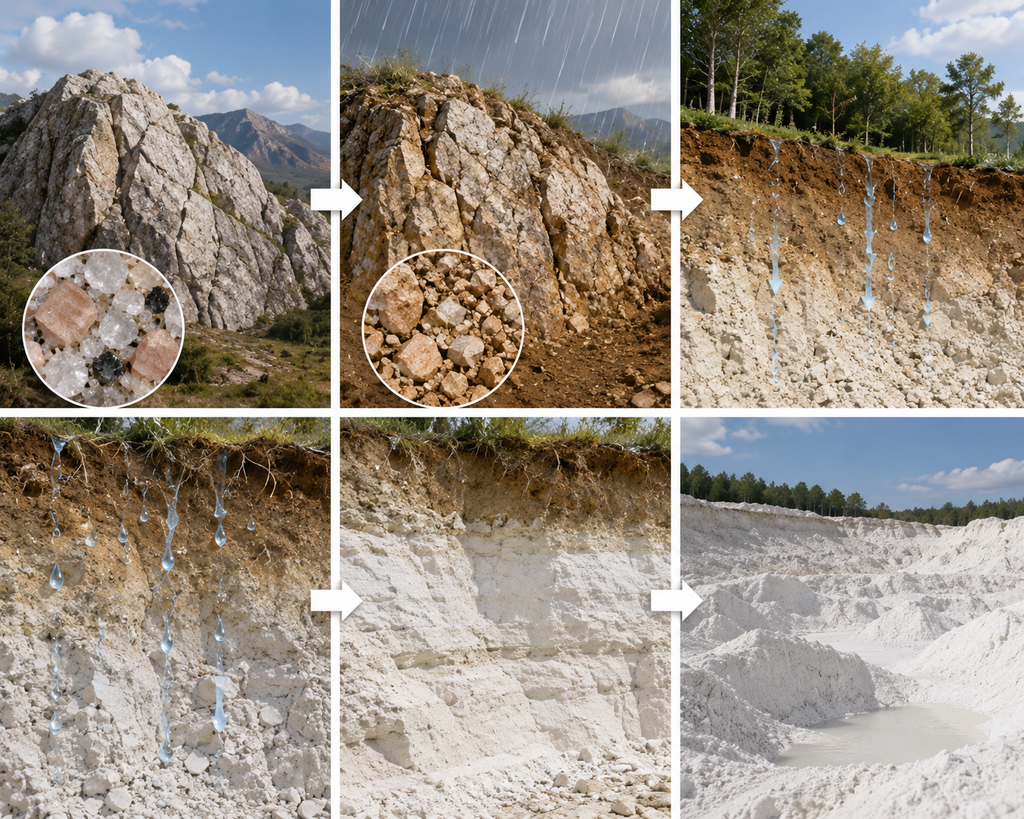
Knowing how it forms helps explain why kaolin is found in certain places. It is a mineral that develops slowly, naturally and depends on the climate.
Five stages are involved in the formation of a new structure.
- The rainwater is mixed with the carbon dioxide that exists in soil and atmosphere.
- The combination of these two acids creates mild carbonic acid.
- Carbonic acid can penetrate granite rock beneath the surface.
- The hydrolysis reaction begins. This breaks down granite, washing away the soluble ions such as potassium, sodium and calcium.
- Kaolinite, the mineral that we call kaolin.
The process is only able to thrive in areas with high humidity, temperatures and rainfall. This is why subtropical and tropical regions such as India, Brazil and China have a high concentration of kaolin. These areas are rich in clay because of the same climate conditions that make them lush.
Kaolin is formed chemically when granite undergoes hydrothermal degradation over many millions of years. The rock parent usually includes muscovite quartz feldspar and anatase. After these parent rocks weather and rearrange themselves, kaolinite is the result.
What are the properties of kaolin clay?
The unique combination of qualities that Kaolin possesses is what makes it so valuable. You can look at the properties in three different groups.
Visual properties
The powdery substance that is Kaolin can be described as fine. It is most commonly known for its bright white colour, but it also comes in shades of yellow, brown, red and pink depending on its deposit.
Physical properties
Kaolin is a versatile material that can be used in a variety of ways.
- It is easy to form and can be used for face masks, ceramics or other products.
- This product is non-abrasive and will not scratch the surface. It’s ideal for products that are gentle, smooth.
- High-binding capability is useful for paper and other construction materials.
Chemical properties
Kaolin is chemically inert due to its neutral pH. The fact that it won’t react to the ingredients it is mixed with, makes it a favorite among pharmaceutical and cosmetic companies. The layered structure of the aluminum-silicate also ensures consistency and stability.
What are the applications of kaolin clay?
Kaolin is used in many industries. These are some of the most important.
- Manufacturing of paper: The use of kaolin as a coating and filler makes the paper more lustrous, brighter and printable.
- Products made of ceramic: They add strength to porcelain and tiles and give them a clean white finish.
- Paints Kaolin is a natural pigment that improves gloss and viscosity. This helps paints to cover and stay on longer.
- Rubber It is used as a filler to reinforce rubber products, improving their durability.
You should consider implementing kaolin if you work in one of the industries listed above. The correct grade will improve your product’s quality, without adding any complexity to the process.
Choosing the Right Kaolin Source for Your Business with Shree Ram Kaolin
Kaolin is available in many different deposits around the world; however, not all are equal. The climate, the mineral content, and infrastructure are all factors that determine how valuable a particular source is for your production. The richest deposits are found in tropical regions such as India and Brazil, while Georgia and Cornwall remain strongholds for the industry in the US.
India is a top choice for buyers who are looking for dependable quality and reliable shipping. Gujarat in particular, with its strong reserves, offers world-class access to ports. Businesses seeking a trusted kaolin manufacturer can benefit from the region’s established mining and export infrastructure. In a world where global demand is increasing and resources are plentiful, it makes sense to source from an area that has been built for both quality and export.
Next, match the grade to your specific industry needs. Choose the best kaolin supplier today to ensure your products’ quality for many years.
FAQs
In India, kaolin clay is found in Gujarat, Rajasthan and West Bengal. It can also be found in Karnataka and Odisha. Gujarat, especially the Kutch district and Bhavnagar district is the best location to buy kaolin clay because it has the highest quality and the closest international ports.
Granite is the natural source of kaolin. Over millions of years, parent minerals like muscovite quartz, feldspar and anatase are weathered down to kaolinite. This mineral is the mineral used in kaolin.
Georgia is the largest producer of kaolin, with 94% of the total US production. Sandersville, the city that is the center of the industry, has been dubbed the “Kaolin Capital of the World.”
No. Multani mitti is bentonite, which has a chemical composition that differs from kaolin.
Paper, ceramics and rubber are all made with kaolin clay. Cosmetics and pharmaceuticals also use it. The clay is used as a binder, thickener and brightener to improve the quality of many products.
India has vast reserves of ball and china clay, estimated at 986 millions tonnes. The market is expected to grow by $491.5million per year. Gujarat is a reliable destination for buyers from abroad because of its port and infrastructure.

