
What Is Kaolin Clay Made Of? Composition, Properties, and Common Uses

It is an incredibly soft, white, naturally-occurring clay. Kaolin has been widely used in many industries, including ceramics, cosmetics and construction. The smooth texture, the light color, and its ability to absorb water make it an extremely valuable mineral. What exactly is Kaolin Clay made from?
The mineral kaolinite is the main component of Kaolin Clay. It belongs to the group of clay minerals. The clay forms when certain rocks, primarily feldspar rich rocks, are weathered and undergo chemical changes over a long period of time. Natural kaolin can contain a small amount of minerals in addition to kaolinite, depending where the deposit was formed.
What Is Kaolin Clay?
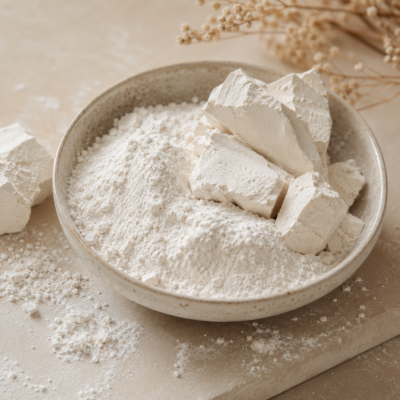
Kaolin is an incredibly fine-grained clay, which is typically white or off-white. The clay is known also as China Clay because it has been used for a long time to make fine ceramics and porcelain.
Named after the Chinese Gaoling clay deposit, “kaolin”, is a name that was given to an ancient area known for its deposits of clay. Kaolin is currently mined and processed in different countries for a variety of industrial and commercial purposes.
Kaolin, unlike some clays has a relatively low level of plasticity. It does not get extremely sticky when it is mixed with water. The chemical stability of the fine particles and its light color make it a particularly valuable material in manufacturing.
What Is Kaolin Clay Made Of?
The main mineral in kaolin clay is kaolinite, a hydrated aluminium silicate. Its chemical formula is commonly written as Al₂Si₂O₅(OH)₄.
Kaolinite is made from three primary elements:
- Aluminium
- Silicon
- Oxygen
- Hydrogen, which is present in its hydroxyl groups
The exact composition of natural kaolin can vary because deposits may contain small quantities of other minerals and impurities.
How Does Kaolin Clay Form?
The formation of kaolin clay is a result of a natural geological phenomenon called Chemical Weathering. Water and environmental factors can break down rock minerals over time.
Feldspar, one of the main source minerals. If feldspar rich rocks are subjected to acidity and moisture, they can slowly decompose. Some of the minerals that were originally present are converted into kaolinite during this process.
It is possible to extract and process the resulting deposit of kaolin in order to improve its characteristics, such as purity, brightness and particle size.
What Other Minerals Can Be Found in Kaolin?
Although high-quality kaolin can contain a very high proportion of kaolinite, naturally mined material is rarely made up of only one mineral.
Depending on the deposit, kaolin may contain small amounts of minerals such as:
- Quartz
- Mica
- Feldspar
- Iron-bearing minerals
- Titanium minerals
- Other clay minerals
The addition of minerals to the kaolin can alter its colour, brightness and texture. It may also affect performance. In order to remove impurities from kaolin and create kaolin that is suitable for a specific application, industrial processing can be used.
Why Is Kaolinite Important?
The most important characteristics of kaolin are derived from kaolinite. The fine particles and chemically stable structure of kaolin make it ideal for applications that require consistency and purity.
The Kaolinite mineral is relatively less expansive than some clay minerals. It is good for industries that have problems with excessive swelling.
Physical Properties of Kaolin Clay
Kaolin is known for several distinctive physical properties. It is generally:
Fine and soft
- White or light in colour
- Low in plasticity compared with many other clays
- Chemically stable
- Relatively non-abrasive
- Capable of absorbing moisture
- Available in different particle sizes after processing
The specific properties depend on the geological source and the processing methods used.
How Is Kaolin Processed?
Kaolin may be processed in several stages, depending on the intended application. The processing can involve crushing, screening, separation and washing.
Additional beneficiation processes can be applied to remove impurities in certain applications that require very high purity and brightness. After a final classification, the product is classified according to its particle size, brightness and moisture content.
Common Uses of Kaolin Clay
Kaolin’s composition and physical properties make it useful across many industries.
Ceramics and Porcelain
Kaolin is an important raw material in ceramic manufacturing. It contributes to the strength, whiteness, and firing characteristics needed to produce porcelain, sanitaryware, tiles, and other ceramic products.
Paper Manufacturing
In the paper industry, processed kaolin can be used as a coating and filler material. It can improve the surface appearance, smoothness, opacity, and printability of paper.
Paint and Coatings
Kaolin is also used in paints and coatings. Its fine particles can contribute to opacity, texture, durability, and surface finish while helping manufacturers formulate products with specific performance characteristics.
Plastics and Rubber
Kaolin that has been processed can be used as functional filler for certain rubber and plastic products. This can affect properties like stiffness, dimensional stabilty, surface finish and processing behavior.
Is All Kaolin Clay the Same?
No. The kaolin deposits can differ significantly. Its performance can be affected by differences in its geological formation, mineral composition, particle size and brightness.
Buyers often choose kaolin for industrial purposes based on technical specifications, rather than choosing the product simply because it is called “kaolin clay.” The factors that may be considered include moisture content, particle distribution, brightness and purity.
Final Thoughts
What is the primary ingredient of kaolin? Kaolinite is an naturally occurring, hydrated aluminium-silica with the chemical formula, Al2Si2O5 (OH)4. The natural kaolin clay can contain small quantities of other minerals, such as mica, quartz and feldspar. It may also be a mixture with iron or titanium.
Kaolin’s composition is unique, giving it many valuable qualities, such as fine particles, a light color, chemical stability and low plasticity. This is why kaolin has been widely used for many years in the ceramic, paper, paints and plastics industries, as well as cosmetics.
Knowing what kaolin is composed of will help buyers and manufacturers choose the best grade to meet their application requirements.

